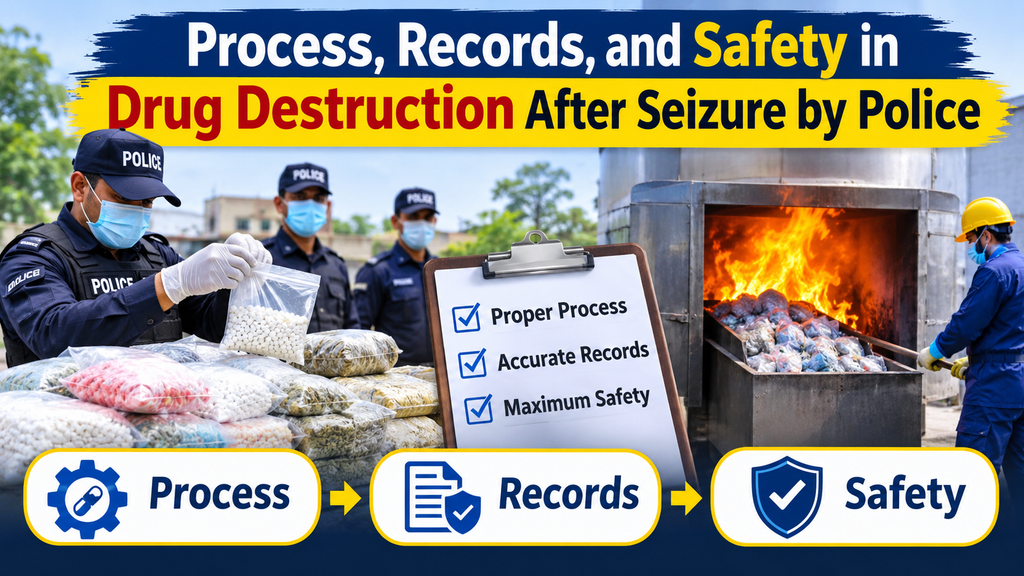
How police destroy seized drugs is rarely as straightforward as removing a package from an evidence locker and throwing it away. A 2025 federal case in Florida showed the consequences when drugs in law-enforcement custody are diverted, and records are falsified to make the evidence appear destroyed.
Former Florida Highway Patrol trooper and DEA task-force officer Joshua Grady Earrey was sentenced to nine years in federal prison in April 2025 after pleading guilty to federal offenses involving drug distribution and defrauding the United States. According to the U.S. Department of Justice, Earrey and a co-conspirator stole more than 1,000 pounds of marijuana from evidence and submitted falsified paperwork showing that the drugs had been destroyed.
The case puts a rarely discussed part of law enforcement operations in focus: what happens to seized drugs after they’re no longer needed as evidence?
What Happens to Seized Drugs After a Case?
Seized drugs remain as evidence until the agency determines that they’re no longer needed for an investigation, prosecution, appeal, or another legal purpose. The evidence must remain identifiable, secure, and traceable throughout that period.
Federal oversight of DEA evidence illustrates the basic process. The DEA has historically required drug evidence to remain secured until it’s no longer needed and has required approval before evidence is released for destruction. The final stage therefore starts with authorization, not with the destruction method. Evidence personnel need to establish which items are eligible for destruction, reconcile the physical evidence with inventory records, and document the transfer into the destruction process.
For agencies that don’t maintain specialized destruction infrastructure, a controlled-substance destruction provider such as GAIACA provides secure on-site destruction services designed to support documented chain of custody, compliant handling, and final destruction without requiring departments to develop the necessary infrastructure themselves or transport the substances to an incinerator.
Florida Case Shows Why Destruction Records Matter
The Earrey case involved drugs that had already entered law-enforcement custody. According to federal prosecutors, Earrey and his co-conspirator stole drugs seized during criminal investigations and provided them to others for distribution. The pair stole more than 1,000 pounds of marijuana and covered up the theft with falsified paperwork showing that the drugs had been destroyed. They also stole a kilogram of cocaine from evidence and gave it to a drug dealer.
The case is significant for evidence managers because it highlights a distinction between recording a destruction and completing a destruction. A certificate, inventory entry, or other record doesn’t physically remove a controlled substance from circulation. The agency still needs controls that connect the evidence record to the actual destruction event.
That connection becomes especially important when large quantities of controlled substances are involved. A department may have evidence stored for months or years while cases move through investigations and courts. Each transfer creates another point at which inventory records, physical custody, and authorization need to remain aligned. The Florida case also shows the potential consequences when those controls fail. Drugs that were supposed to remain in government custody allegedly returned to the illicit market instead.
How Police Prepare Drugs for Destruction
The destruction process begins with determining that the evidence is eligible for disposal. Evidence personnel generally need to verify the evidence identifier, substance, quantity, case information, and current status. The department also needs to confirm that no investigative, prosecutorial, or judicial requirement still calls for the evidence to be preserved.
The exact authorization process varies by jurisdiction and agency. Some cases require prosecutorial approval, court authorization, or both. Agency evidence policies can also establish additional requirements before controlled substances leave secure storage.
Chain-of-custody records remain important at this stage. A seized substance might have moved from an arresting officer to an evidence technician, then to a laboratory for testing, back into secure storage, and finally to a destruction provider. The final transfer becomes part of the evidence history rather than a separate administrative event.
Documentation should allow the agency to establish what was transferred, who released it, who received it, when the transfer occurred, and what ultimately happened to the material.
How Are Seized Drugs Destroyed?
There isn’t one destruction method that applies to every controlled substance or every law-enforcement situation. The appropriate method depends on the substance, quantity, facility, applicable regulations, and destruction pathway. Incineration is one established approach for controlled substances, but DEA regulations use a performance standard focused on achieving a non-retrievable result rather than requiring one universal technology in every circumstance. The DEA defines the standard in terms of permanently rendering the substance unusable and preventing it from being transformed back into a controlled substance or controlled-substance analogue.
DEA guidance also recognizes destruction methods other than incineration when the applicable requirements are satisfied. For registrants destroying controlled-substance inventory, the agency states that substances must be rendered non-retrievable and that applicable federal, state, tribal, and local requirements must also be followed.
For police departments, the important question is therefore not simply whether a method is familiar. The agency needs to know whether the chosen destruction pathway is appropriate for the evidence and satisfies the requirements that apply to that material and jurisdiction.
Safety Is Another Part of the Destruction Process
Drug destruction also presents physical hazards that aren’t present with ordinary evidence disposal. Evidence personnel frequently encounter powders, tablets, contaminated packaging, damaged containers, or substances with unknown concentrations. Potent synthetic opioids and other hazardous substances create additional concerns for employees who handle or transport evidence.
The appropriate response depends on the substance and circumstances. Departments need procedures covering hazard identification, appropriate personal protective equipment, containment, spill response, transportation, and escalation to personnel with specialized training when necessary.
Those considerations become particularly important when an agency handles large quantities or mixed evidence. A destruction process designed around ordinary pharmaceutical waste might not be appropriate for bulk seized drugs or materials with unknown hazards.
What a Complete Drug Destruction Process Looks Like
For law enforcement agencies, seized-drug destruction is the final stage of a much longer evidence lifecycle. The process starts with seizure and secure storage. It continues through laboratory analysis, investigative and court requirements, inventory reconciliation, authorization, and controlled transfer. The final stage involves destruction through an appropriate method and documentation showing what happened.
The Florida case involving Earrey demonstrates why that last stage deserves attention. The alleged theft didn’t involve drugs sitting outside the evidence system. The drugs had already been seized and placed into law-enforcement custody, and prosecutors said falsified destruction paperwork was used to conceal their removal.
Police departments need to demonstrate that eligible evidence moved through a secure and authorized process and that the controlled substances were actually destroyed. That makes drug destruction both an operational and accountability issue. Secure handling, chain-of-custody controls, appropriate destruction methods, witness verification, and accurate records all contribute to the same objective: ensuring that seized drugs don’t return to circulation after they’ve entered police custody.