For restaurants trying to grow in the delivery era, the biggest challenge is often not the food. It is the operational chaos behind the screen.
An operator may be listed on Uber Eats, DoorDash, Grubhub and other platforms all at once, with orders arriving from different channels, drivers coming and going, menus needing constant updates and kitchen teams trying to keep pace without making mistakes. In that environment, speed matters, but so does control. A delayed handoff, a missed ticket or a disconnected system can quickly turn into a bad review, a lost customer and thinner margins.
That is the problem CloudKitchens has built its business around solving.
“CloudKitchens was built to solve a fundamental challenge in the restaurant industry: the high cost and complexity of expansion in an age when delivery demand is skyrocketing,” a company executive said.
CloudKitchens is best known as one of the world’s largest ghost kitchen providers. It “reimagines restaurants” by prioritizing seamless online ordering, minimizing costs and maximizing profits for food businesses. The company provides the space, technology and operational support to help food entrepreneurs launch or scale quickly in the delivery era.
“Our model addresses these trends head-on,” the executive said. “We allow restaurants to grow digitally and geographically with lower risk, meeting customers where they are without needing expensive high-foot-traffic real estate.”
At the center of its model is a technology layer designed to simplify how restaurants manage off-premise demand. The company’s system brings orders from multiple delivery apps into one interface, gives operators real-time visibility into performance and reduces the friction that can slow kitchens down during peak volume.
“We’ve essentially removed the operational complexity that comes with managing multiple delivery channels,” the executive said. “By bringing everything into one system, operators can focus on speed, accuracy and the customer experience.”
How CloudKitchens Solves One Of The Biggest Pain Points For Operators
If the first challenge in delivery is managing complexity, the second is finding a system that can actually handle it at scale.
Many ghost kitchen providers stop at the basics, offering space, utilities and little else. CloudKitchens has taken a different approach, building a model that blends technology, real estate strategy and operational support into a single, integrated system.
At the center of that differentiation is its proprietary technology platform, Otter. The software consolidates orders from multiple delivery apps into one device, eliminating the need for operators to manage several tablets at once. It also provides real-time analytics and point-of-sale capabilities, giving restaurant teams visibility into performance as orders are coming in.
“We’ve solved one of the biggest pain points for operators, which is managing multiple delivery platforms at once,” a company executive said. “By bringing everything into a single system, we’re helping restaurants operate more efficiently and with greater accuracy.”
The impact is not just convenience. By streamlining order flow and reducing manual processes, the system helps minimize errors, improve ticket times and create a more consistent customer experience. It also gives operators access to data they would not typically have in a traditional kitchen environment, from peak ordering patterns to menu performance.
However, the technology is only one part of the equation.
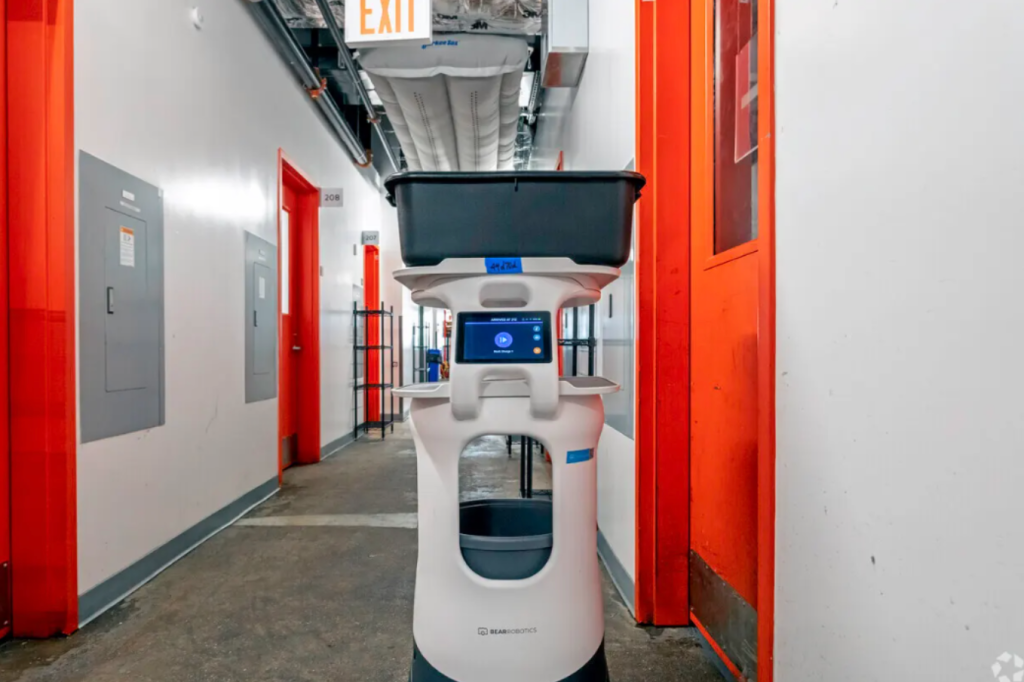
CloudKitchens has also built a real estate strategy designed specifically for delivery. The company acquires and converts underutilized properties, including warehouses, parking structures and older commercial sites, into kitchen hubs located in high-demand urban areas. These facilities are purpose-built for efficiency, often incorporating features like optimized kitchen layouts, centralized pickup areas and automated handoff systems.
Since the company owns and controls these properties, it can standardize operations across locations and invest in infrastructure that smaller providers may not be able to match. The result is a network that allows restaurant brands to expand into new markets quickly, often using the same operating model in multiple cities or even countries.
“Our scale allows us to bring consistency and efficiency to every location,” the executive said. “Operators can expand with confidence because they know exactly what they’re getting, whether they’re opening one kitchen or ten.”
Equally important is the level of operational support built into each facility. Unlike traditional shared kitchen models, where operators are often responsible for managing everything beyond the kitchen itself, CloudKitchens provides on-site teams to handle logistics such as driver coordination, order handoff, cleaning, maintenance and security.
That support removes another layer of friction from the process. Kitchen staff can stay focused on food preparation while the company’s teams manage the flow of drivers and ensure orders are correctly dispatched. It also creates a more controlled environment, reducing the risk of delays or breakdowns during peak hours.
“We’re not just providing space, we’re providing a full-service operating environment,” the executive said. “From logistics to on-site support, we’re focused on making sure our partners can run efficiently every day.”
CloudKitchens Success Stories And Reviews: Scaling Faster, Operating Smarter
The impact of CloudKitchens’ model is most clearly seen in how its partners grow.
For global brands, the platform has become a faster, lower-risk way to enter new markets. Five Guys used CloudKitchens to launch a delivery-only kitchen in San Francisco, reaching thousands of new customers without the cost of a traditional storefront. Within weeks, the location was fulfilling hundreds of orders per day, proving that expansion no longer requires a full physical footprint.
“We’re pumped to be the first Five Guys location opening in San Francisco and can’t wait to start serving our iconic burgers, hot dogs, fries, and milkshakes to the city,” said franchisee owner Sanjeev Kumar of Tripart Management. “Partnering with CloudKitchens has finally given us a way to enter the market, and we’re excited about what’s ahead.”
Entrepreneurs are seeing similar momentum, often at an accelerated pace. Wesley Li, founder of Happy Holdings, scaled from a single kitchen to multiple locations across two cities, with break-even timelines shrinking from four months to just four weeks. By leveraging CloudKitchens’ technology and operational support, he was able to handle high order volume while maintaining efficiency, turning early success into rapid expansion.
“Aligning with CloudKitchens has been a transformative experience, significantly broadening our perspective on the potential within the delivery sector of the restaurant industry,” Li shared. “This partnership has illuminated the vast scope for enhancements and added value in the delivery domain.”
For established operators, the model has created new revenue streams and improved margins. Dickey’s Barbecue Pit increased total orders by 25 percent after opening a delivery-focused kitchen, while also reducing labor and overhead costs. Without the burden of a dining room, the business was able to serve more customers and keep a larger share of each sale. The owner described the ghost kitchen as “our secret second restaurant that sells just as much as the first, at a fraction of the expense.”
Across these examples, the outcomes are consistent: faster market entry, lower costs and more efficient operations. In customer reviews, operators frequently point to the same advantage, the ability to manage multiple delivery platforms through a single system while reducing errors and improving speed.
What’s Next For CloudKitchens: Expansion, Innovation And A Broader Delivery Ecosystem
As demand for delivery continues to reshape the restaurant industry, CloudKitchens is positioning itself for its next phase of growth, one defined by expansion, new capabilities and a wider range of partners.
The company plans to deepen its presence in existing markets while entering new cities and countries where delivery demand remains high. Already operating across dozens of countries and major urban centers, CloudKitchens sees continued opportunity in dense, food-driven markets where traditional expansion remains costly and complex.
“We see a significant opportunity to continue building the infrastructure for food delivery worldwide,” a company executive said. “Our focus is on expanding into new markets while maintaining the efficiency and consistency our partners rely on.”
At the same time, the company is investing in new capabilities designed to improve the customer experience and increase order volume for its partners. A key initiative is the expansion of its “Picnic” digital food hall concept, which allows customers to order from multiple restaurants in a single transaction, often with no delivery fee through batched drop-offs. The model, already tested in cities like Chicago and Los Angeles, is expected to scale into office buildings, residential complexes and campuses, creating new opportunities for group ordering and higher-volume delivery.
CloudKitchens is also broadening the types of businesses it serves. While traditional restaurant brands remain core to its platform, the company is seeing increased interest from consumer packaged goods companies and non-traditional food operators looking to engage customers directly. At the same time, it continues to deepen relationships with major restaurant chains, many of which are exploring multi-city expansion strategies through delivery-first kitchens.
“We’re seeing a wider range of partners embrace this model,” the executive said. “From established brands to new concepts, the common goal is reaching customers more efficiently and at scale.”
By: Chris Bates